Trulli Historic...
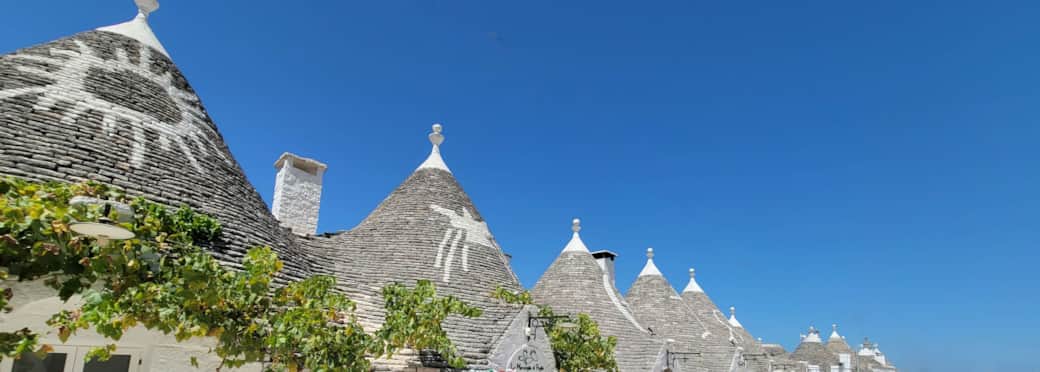
The very first trulli date back to prehistoric times. The trullo (plural trulli) was a type of rural building that was very common in the Murgia dei trulli region, a plateau located between the cities of Bari, Brindisi and Taranto in the Puglia region of southern Italy. This was literally a hut with walls and a dome made from dried stone, which housed a little area used for living, the entrance to which was covered by a pediment. There were one or two smaller rooms for sleeping at night or cooking and heating, which opened onto the main room with a keyed arch.
Depending on the situation, the trullo could be a temporary or seasonal residence, or a permanent dwelling for peasants and agricultural workers. There are examples scattered across the countryside, but there is also a real cluster of them in Alberobello in the province of Bari. The area with the most trulli is the Itria Valley, between Alberobello, Locorotondo, Cisternino and Martina Franca.
The trullo was an eminently rural type of building. With its thick walls and inability to accommodate multi-storey structures, a significant amount of floor space was wasted and, for this reason, it was not well-suited to high-density areas, despite the fact that being built with small stones made its shape flexible and adaptable, which was particularly valuable in urban spaces where space was at a premium.
Rooms beneath the trullo of varying sizes, which were augmented with underground passages and recesses, could be joined together in multiple ways to satisfy simple or complex needs. It was possible to build trulli without spending a lot of money, thanks to locally sourced materials. But there were drawbacks : the enormous impact of load-bearing walls on the ground, the inability to build multi-storey structures, the need to cover every space with a cone, which required hundreds of hours of skilled, painstaking labour.
In the countryside, trulli were built individually or in pairs, in groups of three, four or five, or sometimes in large farms (masseria, pl. masserie) with a dozen, or even two dozen, domes, but they never housed more than one rural family.